
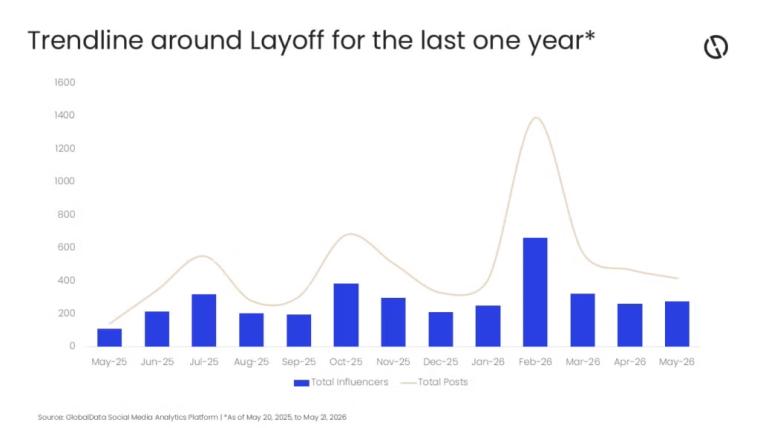
Layoff discussions among the influencers on the “X” platform over the last 90 days (20 February to 21 May 2026) signal a surging moment where workforce budgets are being diverted into massive digital infrastructure for staying ahead in the tech race. This structural shift suggests a permanent move in how organizations spend their money, as capital flows away from traditional resources to fund the infrastructure of the intelligence age.
Influencers warn that this transformation means the standard corporate career is no longer a guaranteed path to stability, but has instead become a variable cost subject to the rapid growth of automated systems, says GlobalData, a leading intelligence and productivity platform.
Shreyasee Majumder, Social Media Analyst at GlobalData, comments: “Influencer sentiment regarding the recent wave of job cuts highlights a growing suspicion of corporate narratives, with many observers labeling the trend as AI washing. For the broader market, this represents a disruptive shift where investors now reward smaller workforces as a symbol of innovation, which pressures even stable organizations to automate roles before the technology is fully ready.”
Structural shift toward lean design
Influencers are of the opinion that traditional corporate hierarchies are becoming obsolete burdens that hinder rapid decision making. Many organizations are aggressively flattening their structures by removing middle management and replacing manual coordination with autonomous software agents. This shift signifies a permanent rotation of capital where money previously spent on human capital is now being diverted to fund massive data center and computing infrastructure.
“We’re already seeing that the intelligence tools we’re creating and using, paired with smaller and flatter teams, are enabling a new way of working which fundamentally changes what it means to build and run a company. and that’s accelerating rapidly….” – Chandra R. Srikanth, Executive Editor at Moneycontrol.com
Industry impact and the consumption crisis
Influencers are highlighting a systemic “AI Layoff Trap” where corporations risk bankrupting their own future by automating away the purchasing power of the global middle class. They warn that replacing personnel with software creates a self-reinforcing doom loop where widespread job losses lead to a collapse in discretionary spending and collective corporate revenue. This structural shift suggests that while individual firms may gain short-term efficiency, the collective industry faces total demand destruction as the very people who consume their services are permanently removed from the economy.
“The doom loop — AI-driven layoffs leading to reduced spending, leading to reduced revenues, leading to further automation, leading to AI-driven layoffs — is already underway. Our economy might be able to handle this if spread over 5-10 years, but not under the accelerated timeline we’re seeing.” – Chris Martenson, Economic Researcher
Future outlook and the orchestration mandate
Influencers opine the future of employment depends on a radical shift from performing manual execution to providing high-level orchestration of autonomous systems. As traditional entry points vanish and junior roles are permanently archived, prominent voices suggest that human labor is increasingly becoming an optional component of the global economy. This transition is prompting calls for new social contracts like universal high income to maintain stability in a world where machine productivity is the primary engine of wealth.
“The career ladder didn’t break. It disappeared. AI isn’t causing layoffs. It’s causing non-hiring…Junior roles? Quietly disappearing. Training grounds? Shrinking. The pyramid is turning into a diamond, heavy middle, no base. And here’s the paradox: No juniors → No future seniors. The real shift? From execution → orchestration.” – Dev Khanna, Technology Expert
Majumder concludes: “The primary risk facing companies is an impending institutional knowledge drought caused by cutting junior roles, which threatens future leadership pipelines in the orchestration economy. This strategic error creates a critical talent gap for the future, rather than just immediate staffing issues.”
There are no comments
Please login to post comments