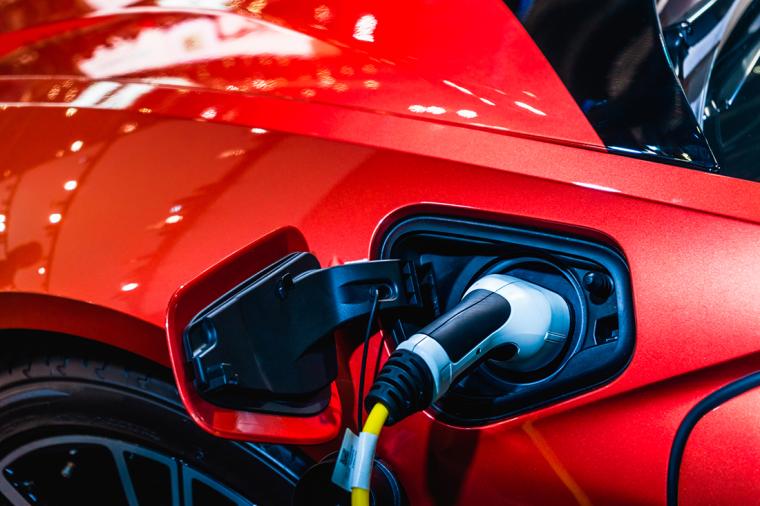
Spurred by the passage of state and federal regulations and legislation in 2020 and 2021 that significantly impacted vehicle emissions, facilities producing electric vehicles (EV) began ramping up with record speed, followed closely by lithium battery and recycling plants. These projects came with billions of dollars in investment, favorable government incentives and thousands of jobs. Locations were based on labor, incentives and the availability of infrastructure – electricity generation in particular.
Today, industry leadership and consumers are left wondering if the nation really had the infrastructure to accommodate the changes as rapidly as predicted.
Charging stations were not readily available despite muti-billion-dollar investments by Ford, BMW, Toyota and others, but many believed that the EV producers would make change happen rapidly. Fortune 500 companies don’t make investments based on the way the wind is blowing — or do they?
Ford’s Blue Oval project in Tennessee, designed to assemble electric F-150s, was the early poster child for the predicted switch to EVs. The combined car/battery facility, first announced in 2021 in combination with South Korean partner SK On, boasted $5.5 billion in investment and the creation of 6,000 jobs.
The state committed $500 million to support the project, with that number eventually swelling to $850 million. It was later surpassed by the Bryan County, Georgia Hyundai facility at $7.6 billion in investment and 8,500 direct jobs. The State of Georgia has pledged a $2.1 billion incentive package in the facility just outside Savannah.
Then came the 2024 election, when the trade winds changed along with consumer appetites. The federal tax incentives for purchasing EVs that made them cost-competitive with combustion engines mostly evaporated, as did many regulatory mandates.
Unfortunately, the pre-election mandates and incentives were baked into business models for EV companies. EV sales have softened and many of these projects have required major restructuring, scaling back or repurposing. Some have been completely shelved.
However, while 100 percent electric vehicle sales are down, the same cannot be said of hybrids. Hybrid ICE/EV hybrids make up roughly 16 percent of the auto market and have grown 30 percent year over year. With uncertainty regarding the Middle East pushing the average price of gasoline to more than $4.32 a gallon, there is no reason to believe hybrid sales will drop soon, and EV sales may bounce back. While EV itself may be temporarily stalled, it would be a mistake to presume that the industry is dying. Hybrid and electric vehicles are not going away; too much has been invested, and oil is still a finite resource.
For the leaders of EV and battery businesses that are experiencing change and slowdowns, it’s important to remain in close contact with state and local economic development teams.
These organizations are charged with being good stewards of taxpayer dollars and the last thing they wish to see happen is those dollars going down the drain with no payback. There are, however, ways to renegotiate potential clawbacks and lessen short-term financial pain. Many companies have received concessions and extensions upon request.
Other companies have successfully offered to make early paybacks at a lesser amount (offers that were accepted to ensure that money was retained for reinvestment). In much the same way, utility providers may seek to claw back power commitments for projects with scaled-back power needs. If public officials play hardball, investing companies will find it in their interest to ride out current agreements as long as possible and consider them interest-free loans. T&ID
Contributor: Daniel Young serves as Director of Economic Development at Moore & Van Allen PLLC and has 30+ years of senior level experience in economic development projects. In his prior role as executive director of the South Carolina Coordinating Council for Economic Development, Young was responsible for negotiating South Carolinaís discretionary incentive programs. He served in this role under three governors and four commerce secretaries, representing the state in negotiating, siting and developing economic development projects of all sizes, including projects with Boeing, Continental Tire, Michelin and more.
About the Author