
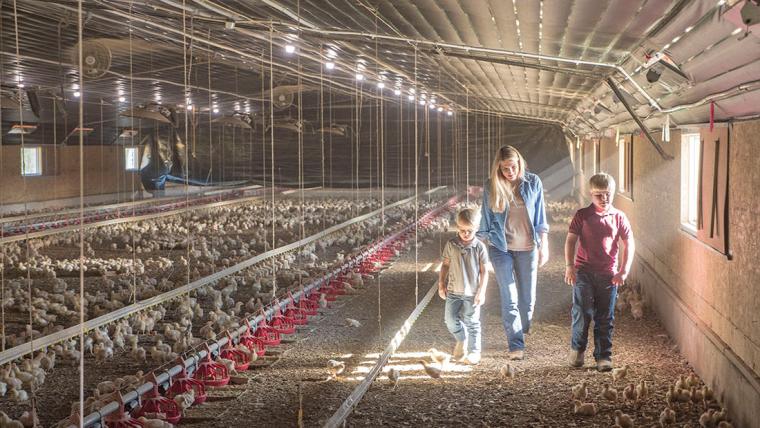
The United States leads the world in agricultural exports and overall food supply impact thanks to vast regions of farmland that include all the elements necessary for growing, harvesting, processing, storing and shipping food products both across the United States and abroad. In fact, the U.S. is the largest food exporting country in the world, shipping between $181 billion to $193 billion worth of agricultural products each year.
Technology and business changes continue to shift the food growing and production landscapes, and the following regions of the United States are not resting on their agricultural laurels: they continue to adapt to change to ensure a ready supply of food for Americans and countries abroad.
Huber Heights, Ohio
Huber Heights, a suburb of Dayton that spans both Montgomery and Miami counties, is home to a variety of key food and beverage production assets that anchor the community within a broader, highly concentrated agricultural processing corridor. Companies such as Prairie Farms Dairy and The Coca-Cola Company operate directly within Huber Heights, supporting regional dairy processing and large-scale beverage production and distribution. These operations highlight the city’s role as an active participant in the food supply chain.
In addition, the area is home to several other major national and global food and agricultural companies, including Cargil, which operates a significant corn milling facility producing sweeteners and starches; SugarCreek, a producer of bacon and ready-to-eat protein products; and Primient, a producer of plant-based ingredients.
Huber Heights benefits from its position within one of the most productive agricultural areas in the U.S., where high-yield farmland consistently produces corn, soybeans and livestock inputs that feed directly into the food production pipeline. This proximity to raw agricultural commodities significantly reduces supply chain complexity and input costs for processors. At the same time, the region has developed a deep and experienced workforce with roots in manufacturing, food processing and distribution.
Accessibility in Huber Heights extends beyond transportation infrastructure to include one of the region’s most valuable natural assets: an abundant and reliable water supply. The community sits atop the Great Miami Buried Valley Aquifer, one of the largest underground aquifer systems in the Midwest. This aquifer contains plentiful high-quality groundwater and is continuously replenished, providing a sustainable, cost-effective water source.
Huber Heights is strategically located at the intersection of Interstate 70 and Interstate 75, providing direct access to major north-south and east-west freight corridors. The region is further supported by rail infrastructure for bulk commodity movement and by nearby air cargo capabilities for time-sensitive distribution. Combined with existing warehousing, cold storage and food-grade industrial facilities, this connectivity allows producers to efficiently move raw materials and finished products throughout the country.
In recent years, Huber Heights and the surrounding area have seen steady investment in food production, processing and logistics, reinforcing the region’s role as a reliable, scalable location for the industry.
Huber Heights offers a competitive, business-friendly incentive environment designed to support food growers, processors and manufacturers at every stage of development. The city can provide targeted tools, such as property tax abatements, job creation incentives and infrastructure support to help offset upfront project costs and accelerate timelines. In addition, companies benefit from efficient permitting processes, responsive local leadership and competitive utility rates, which are particularly important for water- and energy-intensive food production operations.
“What sets Huber Heights apart is our ability to deliver the essentials food producers need — reliable water, strategic location and a city that moves at the speed of business,” said Jason Antonick, City of Huber Heights Economic Development Director. “Companies locating here aren’t navigating layers of complexity; they’re working directly with a community that’s prepared to support their growth from day one.”
Greater Sacramento, California
Nestled at the epicenter of California’s agricultural heartland, Greater Sacramento is innovating across the supply chain, from farming to food processing, to food and plant science. The region’s industry is fueled by an ever-growing pipeline of plant and food scientists from UC Davis — the number one agricultural sciences university in the U.S.
Greater Sacramento is home to renowned producers like Farmers’ Rice Cooperative, Muller Ranch and Morning Star. The region’s millions of acres of farmland produce billions in agricultural value. Top crops include wine grapes, processed tomatoes, walnuts, almonds and rice.
International leaders like Bayer Crop Science, BASF, Novenesis and Syngenta host plant science and biotech research and development operations in Greater Sacramento. Other global leaders in the region include SAKATA and HM CLAUSE.
From discovery to distribution, food-tech and ag-tech solutions are built in Greater Sacramento for use worldwide. Experts across the industry have clustered in the region, facilitating connections and catalyzing innovation.
Two grocery retail leaders, Raley’s and Nugget Markets, have their headquarters in Greater Sacramento, offering companies a direct line to bring their products to market.
The region’s positioning allows food to travel to the Bay Area and into out-of-state markets like Reno. Greater Sacramento is on the I-5 corridor, allowing travel to southern California, Oregon and Washington.
One of the region’s assets includes Food & Health Angels, an angel network rooted in the UC Davis and Greater Sacramento ecosystem that invests in early-stage companies at the intersection of food, health and medicine, pairing capital with deep operator expertise to drive scalable impact and returns.
Additionally, there is Aggie Square, a first-of-its-kind, $1 billion innovation district based in Sacramento. A partnership between UC Davis, the City of Sacramento and Wexford Science + Technology, Aggie Square features 1.1 million square feet of mixed-use development, from commercial labs to classrooms, a residential tower and ground floor public-facing space.
Incentives available in the region include California Competes Tax Credit, SMUD Agricultural Service Rate and Economic Development Rate, PG&E Agriculture Energy Savings cash incentives and financing, CDFA Specialty Crop Block Grant Program, California partial sales and use tax exemption for manufacturing and research and development, New Employment Tax Credit and Employment Training Panel, along with local forgivable loans, per-job incentives, fee deferrals, hiring support and more.
“Greater Sacramento offers a unique combination of world-class agricultural assets, cutting-edge research and a collaborative innovation ecosystem that is accelerating the future of food,” said Barry Broome, President and CEO of Greater Sacramento Economic Council. “From global industry leaders and food processors to startups emerging from UC Davis, companies can access the talent, infrastructure and partnerships needed to innovate, scale and reach markets efficiently. As the epicenter of California’s agricultural heartland, Greater Sacramento is helping shape the next generation of food and ag-tech solutions for the world.”
San Angelo, Texas
Agriculture remains one of the foundational industries of the San Angelo region and West Texas. The area has long been recognized for sheep, goat, cattle, cotton and feed production, as well as meat processing and agricultural services. San Angelo is home to one of the nation’s largest sheep and lamb markets and continues to serve as a regional hub for ranching and agricultural commerce.
Major regional industry players include Lone Star Beef, a large beef processing operation headquartered in San Angelo, and Talk O’ Texas Brands, a long-standing food manufacturer known nationally for its pickled okra products. The region also supports a wide network of ranching operations, feed suppliers, transportation providers and agricultural service businesses that contribute significantly to the local economy.
The area further benefits from agricultural research and workforce partnerships through institutions such as Angelo State University and the Texas A&M AgriLife Research and Extension Center at San Angelo.
San Angelo’s location in West Texas provides access to extensive ranchland, agricultural infrastructure and a workforce with deep roots in farming and ranching. The region’s long history in livestock and agricultural production has created a business environment that understands the needs of producers, processors and agribusiness operations.
The area also offers a lower cost of doing business, available land for expansion and a pro-business climate that supports growth across food production. Existing processing facilities, agricultural suppliers and transportation networks further strengthen the region’s accessibility for food and agricultural operations.
San Angelo is strategically positioned along major transportation corridors serving West Texas and the broader Texas market. The region provides efficient highway access for agricultural transportation and distribution, along with available industrial land, warehousing opportunities and regional logistics support.
The San Angelo region has continued to diversify and strengthen its economy through investment in manufacturing, energy and infrastructure development. Economic development efforts have focused on expanding industrial capacity, workforce development partnerships and business recruitment initiatives designed to support long-term regional growth.
The area has also seen continued investment in energy infrastructure, manufacturing operations and business expansion projects that support the broader agricultural and food production economy. Workforce training partnerships with local colleges, universities and workforce organizations continue to help meet industry demand.
San Angelo and the surrounding region offer a variety of incentive opportunities depending on project scope and investment level. These may include economic development incentives, workforce training assistance, tax abatements, infrastructure partnerships and support through local and regional economic development organizations. The region works collaboratively with prospective companies to identify solutions that support job creation, capital investment and long-term operational success.
“San Angelo has a long-standing agricultural heritage, but what makes our region especially competitive today is the combination of that legacy with modern infrastructure, workforce partnerships and a business-friendly environment,” said Michael Looney, VP of Economic Development, San Angelo Chamber of Commerce. “From livestock and food processing to advanced manufacturing and logistics, companies here benefit from a community that understands how to support growth.”
Seward County, Kansas
Seward County in southwest Kansas does a few things very well, and two of these things include are agriculture and food production. Millions of acres of cropland support the feedstocks used to fatten the thousands of cattle and hogs that are shipped to local processing plants every day. The region’s recent population growth has been driven by the immigrant community, which has embraced the region and local jobs. Seward County does not face the same challenges as other parts of the country: surface water contamination, suburban sprawl or over-regulation; instead, it has wide open spaces and raw materials ready for value-added products.
Currently, Seward County is home to National Beef Packing, Tuls Dairy Farms, High Plains Ponderosa Dairy, Flora Foods Group, Seaboard Farms, Conestoga Energy and Arkalon Ethanol.
One of the reasons agriculture companies choose Seward County is its central location within the United States, which allows it to ship raw materials and finished products to each coast through a robust highway network and the Union Pacific Railroad. A recent addition to the region’s industry support is a logistics company that provides seamless road-to-rail access so companies can import and export their supplies and products from facility to customer without having to build rail infrastructure.
In recent years, National Beef Packing completed a $350 million new fabrication floor. High Plains Ponderosa Dairy just completed a $168 million expansion, adding two new milking turnstiles, bringing their milking capacity to 40,000 hd/day, twice a day. Flora Foods recently purchased the Kansas Dairy Ingredients facility in Hugoton, Kansas and is already planning to expand that facility.
To attract more companies to its agricultural ecosystem and support the ones already there, state and local incentives have been put in place, including property tax abatements, sales tax incentives, tax credits, workforce training programs and more.
“Food production starts with access to raw materials, but it succeeds with infrastructure, workforce and execution,” said Eli Svaty, Executive Director of Seward County Development Corporation. “Regions that bring those pieces together are becoming prime destinations for companies looking to invest in the next generation of food and protein processing — and Seward County, Kansas is uniquely positioned to deliver on all three.”
Sussex County, Delaware
Sussex County is widely recognized as Delaware’s — and one of the nation’s — leading agricultural regions, with food production embedded into its economy, workforce and land use. It is home to global food processors, including Perdue Foods, Mountaire Farms and Allen Harim, part of the reason it is number one in the U.S. for broiler chicken production. The region also ranks in the top two percent nationally in the value of vegetable production, with more than 1,300 farms.
The region boasts an ideal mix of fertile land, strategic proximity to major metropolitan markets and key transportation infrastructure. Sussex County is located in the heart of the Mid-Atlantic region, within an eight-hour drive of 25 percent of the U.S. population. Highway and railway interconnectivity allow for the efficient and affordable transportation of agricultural products, and proximity to the Port of Wilmington makes the location ideal for importing and exporting, especially for perishable products.
The region’s largest poultry producers are doubling down on the area and continuing to make significant investments in business infrastructure. In addition, readily available commercial and industrial sites are popping up across the county with support from the State of Delaware’s Site Readiness Program, which has invested millions of dollars into creating an inventory of locations suitable for business expansions and relocations. Small and mid-size companies like Tail Bangers, which manufactures and ships dog treats across the country, have also experienced tremendous growth and success, due in part to county economic development finance incentives.
Both Sussex County and the State of Delaware offer a number of grant and loan incentives to support growers and producers, such as the Delaware Agricultural Financing Program, which provides financing support for production, processing, packaging and distribution activities.
“Food production is not just part of Sussex County’s heritage — it’s the foundation of our future growth,” said Andrew D. Harton, Director of Economic Development for Sussex County, Delaware. “From globally recognized processors to next-generation food entrepreneurs, we focus on removing barriers, strengthening infrastructure and ensuring producers have the tools to grow sustainably and competitively.”
Valdosta, Lowndes County, Georgia
Lowndes County is home to a number of large food companies, including Walmart Dairy, Martin’s Famous Pastry Shoppe, Bimbo QSR and South Georgia Pecan. It is also the site of a number of large agricultural formulation organizations, including CJB Companies, CJB Applied Technologies and Corteva, product packaging companies like Arglass and cold storage provider P&B Cold Storage.
The county, which is located in south central Georgia with Valdosta as its county seat, offers abundant agricultural and natural resources. South Georgia’s strong agricultural base provides food and beverage processors with access to raw materials and regional suppliers, helping reduce transportation costs and strengthen supply chain reliability.
Located over the Floridan Aquifer, one of the world’s most productive aquifers, the region provides abundant freshwater capacity essential for food processing and beverage manufacturing operations.
The area’s strategic southeast location along the I-75 corridor means quick access to I-10, providing efficient transportation routes to major Southeast markets, ports and distribution hubs. The region features a strong logistics infrastructure with multimodal transportation connections, including interstate access, rail service, nearby ports and regional air transportation — all critical for moving raw materials and finished products quickly and efficiently.
During the past two years, Lowndes County has experienced significant growth, including the addition of 840 new jobs and $652 million in capital investment.
Recent announcements include the new Walmart 300,000-square-foot milk-processing facility, expected to hire 400 people and play an important role in strengthening the region’s food processing and agribusiness sector.
In addition, Arglass recently completed a transformative $230 million expansion — one of the most significant industrial investments in the region’s history. The expanded facility enhances production flexibility, enabling the plant to manufacture up to eight types of glass containers simultaneously. This capability allows Arglass to respond more quickly to market demand, run smaller and more efficient production cycles, reduce inventory levels and lower investment in molds.
P&B Cold Storage operates a 200,000-square-foot cold storage facility at Westside Industrial Park in Valdosta. The project, which broke ground in May 2024, represents more than $30 million in capital investment and supports approximately 100 jobs in Lowndes County.
A mild climate, strong public-private partnerships and responsive economic development leadership help companies maintain efficient year-round production and distribution operations.
“Companies in the food and beverage industry need reliable access to raw materials, efficient logistics networks, affordable fresh water and room to grow, and our community delivers on all of those,” said Niki Ogletree, CEO and President of the Valdosta Lowndes County Development Authority. “From interstate and rail connectivity to our location over the Floridan Aquifer, Valdosta and Lowndes County also provide the resources and business environment that help food manufacturers operate efficiently and compete in today’s global marketplace.” T&ID
Related Agencies
About the Author