
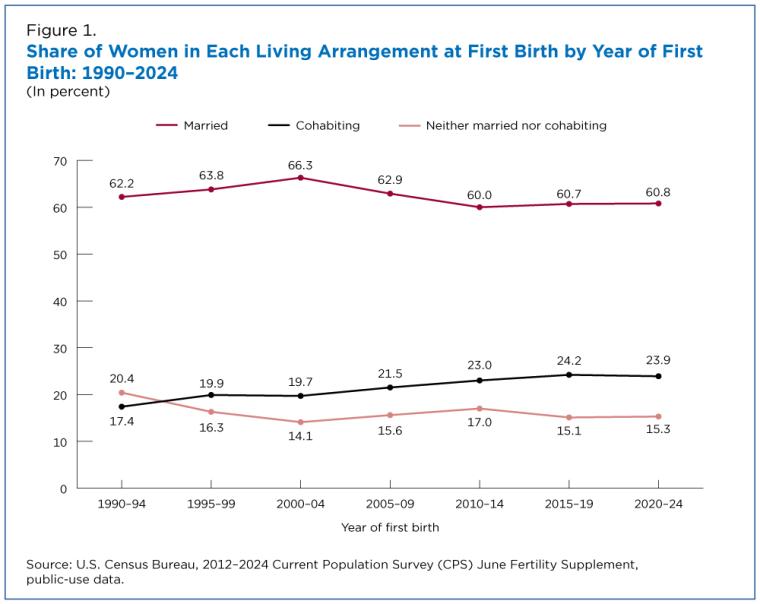
About a quarter (24%) of women who had their first child from 2020 to 2024 lived with an unmarried partner, up from around 17% in the early 1990s, according to a new U.S. Census Bureau report.
But a smaller share of women had their first child while neither married nor living with a partner, dropping from roughly 20% to about 15% in 30 years.
From 2020 to 2024, only about 4% of first-time mothers with a bachelor’s degree or higher were neither married nor living with a partner, and roughly 11% were cohabiting.
During the same time, the estimated share of first-time mothers who were married at the time of birth remained at approximately 60%.
Mothers' Education
Over the years, it also became more common among women with a bachelor’s degree or higher to be married at first birth, with the share jumping from about 75% in the early 1990s to roughly 85% this decade.
From 2020 to 2024, only about 4% of first-time mothers with a bachelor’s degree or higher were neither married nor living with a partner, and roughly 11% were cohabiting.
The opposite occurred among those with less than a bachelor’s degree: fewer were married at first birth (roughly 40% this decade compared to about 60%) but the share living with a partner rose from about 20% to 35%.
These educational differences highlight a growing divide in family stability: socioeconomically advantaged individuals are increasingly likely – and their less advantaged peers decreasingly likely – to be in stable arrangements such as marriage.
Other highlights:
- Between 2020 and 2024, Asian mothers were the most likely to be married at first birth (87.1%), followed by White (71.3%), Hispanic (43.9%) and Black mothers (29.0%), though the difference between Hispanic and Black mothers is not statistically significant.
- Approximately 40% of first-time Black mothers were neither married nor cohabiting at the time of childbirth in 2020-2024, followed by Hispanic (22.2%), White (8.5%) and Asian mothers (5.5%). However, the difference between White and Asian mothers is not statistically significant.
About the Research
All comparative statements have undergone statistical testing and, unless otherwise noted, all comparisons are statistically significant at the 90% confidence level. All data are subject to error arising from a variety of sources, including sampling, nonsampling and modeling. More information about the Current Population Survey Fertility Supplement is available here.
There are no comments
Please login to post comments