
Tomorrow’s innovations are being built today in the Heartland of the United States. New graduates, founders, corporations and families alike are increasingly flocking to the Midwest, driving the region’s renaissance from flyover to “fly to.”
Dreamers, pioneers and risk takers are planting roots in Indiana, where, with Governor Mike Braun at the helm, the government is entrepreneurial, regulations are low, costs are reasonable and the people are community driven.
Governor Braun is readying Indiana for the future thanks to groundbreaking investments and initiatives focused on regional-led strategies, next-generation industries, talent development and quality of place in Hoosier neighborhoods statewide.
Governor Braun calls the state the “shining star of the Midwest.” Under his leadership, Indiana’s GDP growth outperformed the nation and its fellow Midwestern states in 2025 and charted a 5.2 percent increase in wage growth, topping the U.S. average.
“There’s never been a better time to invest in the Hoosier State,” Governor Braun said. “Whether you’re a startup founder, a global manufacturer or a family looking for a new opportunity, Indiana offers the workforce, infrastructure, affordability and quality of life needed not only to succeed here, but to thrive here.”
Strengthening Communities and Industry Clusters
Indiana’s regions are as diverse as its landscapes, from the southern shores of Lake Michigan and the Indiana Dunes National Park & Preserve in northern Indiana to the 23,000-plus-acre forest of Brown County in the Uplands region to the pockets of rolling plains and farmland nestled throughout the state.
In years past, the state led economic development with a top-down approach. Now, Governor Braun is asking regions and those who know their communities best to lead.
Northeast Indiana is home to what’s commonly referred to as the Orthopedics Capital of the World. The ecosystem there – the elected officials, the economic developers, the urban planners, the industry leaders and the talent – know the industry inside and out and they know exactly what it needs to continue growing, thriving and attracting new, high-paying jobs.
Southwest Indiana, on the other hand, has produced more than eight million Toyota vehicles in the company’s nearly 30-year history in Indiana. This OEM employs nearly 8,000 associates and has helped cultivate a robust automotive supply chain in the region.
There, business and community leaders identified talent retention and attraction as a key priority for long-term growth. They developed a data-driven plan to combat population decline, and Governor Braun is a proud backer of it, directing the state to provide match dollars to accelerate projects like The District, a multi-million-dollar housing development that will add 250 units in Toyota’s small community of Princeton and fill a critical gap for employers.
“Not only are these projects being driven by the needs of businesses, but the businesses are also investing themselves,” Governor Braun said.
Just last year, the region cut the ribbon on its brand-new Toyota Indiana YMCA – powered by a $1 million investment from Toyota – which has created talent- and community-focused assets, programming and resources to support health, wellness and quality of life.
“That’s the true power of region-led, industry-aligned economic development,” Governor Braun added.
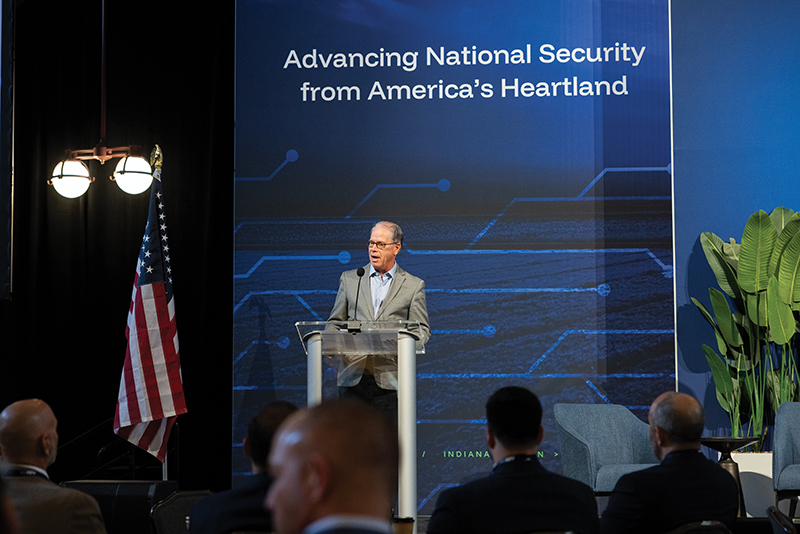
Photo provided by State of Indiana
Investing in the Future of Health and Science
Governor Braun is advancing this approach in new ways, tasking regions to develop formal plans tied to employment growth, per capita income and educational attainment.
In central Indiana, life sciences was identified as a core growth engine for the region, anchored by Fortune 500 leaders, scaling innovators and world-renowned research institutions such as Boston Scientific, Cook Medical, Corteva Agriscience, Eli Lilly and Company, Elanco Animal Health, LabCorp and Roche.
In May 2026, Governor Braun announced a once-in-a-generation, $1 billion investment in the state’s agriculture and life sciences industries.
The initiative aims to build on Indiana’s already robust ecosystem to create 100,000 new jobs in 10 years while solidifying the state as a global destination for human, animal, plant and environmental health.
Through the investment, Governor Braun directed the state to market the many competitive advantages of its growing life sciences and agriculture sectors to attract business expansion and reshoring projects, new investments from companies leading innovation and supporting the broader industry supply chain, and top talent in search of high-growth, high-wage career opportunities.
Indiana already ranks number one in the U.S. for life sciences exports and the state’s agbioscience field contributes more than $72.4 billion to its economy.
“We’re planting a flag in the ground that demonstrates we’re committed to life sciences,” said Governor Braun. “By bolstering this ecosystem, Indiana will be known as a global hub for developing and producing the solutions that are saving lives and improving quality of life – we discover, make and move it here.”
Next-Generation Manufacturing Takes Off
Indiana boasts a storied tradition of advanced manufacturing leadership, accounting for about a quarter of the state’s economic output. Officials have spent years working to future-proof the industry: attracting next-generation manufacturers across energy storage solutions, microelectronics and mobility; encouraging legacy manufacturers to invest in and implement new technologies and processes; and collaborating with businesses and talent partners to train and upskill the state’s workforce.
Today, the results are telling, and Indiana is better positioned than ever to power the world forward.
Governor Braun recently announced that SK Hynix, the world’s leading producer of High-Bandwidth Memory (HBM) chips, is starting construction on its new advanced packaging fabrication and R&D facility in Indiana this year.
The nearly $4 billion investment is expected to drive U.S. innovation and fill a critical gap in the nation’s advanced packaging supply chain, mass producing next-generation chips that are critical components in training AI systems.
The company chose to invest in a robust, regional ecosystem, establishing its hub on 90 acres at the Purdue Research Park in West Lafayette, where SK Hynix will be co-located with one of the nation’s leading research institutions and have access to graduates of Purdue’s comprehensive suite of degrees and credentials in semiconductors and microelectronics – the first in the nation launched in 2022.
"We believe this project will lay the foundation for a new Silicon Heartland, a semiconductor ecosystem centered in the Midwest Triangle,” said SK Hynix President and CEO Kwak Noh-Jung.
SK Hynix’s investment is another proof point that Indiana is home to the world’s newest semiconductor sector.
The state boasts a $10 million public-private microelectronics hub near Naval Support Activity Crane (NSWC Crane) – the third-largest Navy base in the world – and the U.S. Department of Defense’s microelectronics center of expertise as well as Silicon Crossroads, a regional, federally designated hub for microelectronics funded by the CHIPS and Science Act.
A Key Partner in U.S. Defense and National Security
As global dynamics continue to shift and evolve, Governor Braun is focused on Indiana’s role as an emerging center for defense innovation, answering the President’s call to power national security efforts.
“We have the ability and the talent to move quickly from concept to capability, creating high-wage jobs and strengthening our economy while supporting the Department of War,” said Braun.
The state’s leadership rests on its unmatched assets, including its advanced manufacturing base, microelectronics expertise, logistics strength and NSWC Crane defense installation.
Indiana has achieved a 24 percent increase in defense contracts since 2020. In addition to its growing semiconductor supply chain, the state has welcomed significant investments focused on nuclear modernization, hypersonics and munitions production.
Within the last year, officials have broken ground on a new 1,100-acre National Security Industrial Hub and Munitions Campus led by the American Center for Manufacturing & Innovation (ACMI) with funding support from the U.S. Department of War; welcomed a new Kratos Defense & Security Solutions facility for next-generation hypersonic technologies; and announced Indiana as the headquarters and first production site for Prometheus Energetics, supporting its solid rocket motors.
“The United States has no shortage of innovation,” said John Burer, founder and CEO of ACMI Group. “What it lacks is production capacity at scale. ACMI’s mission is to close the production gap by aligning government demand, private capital and modern manufacturing infrastructure.”
“Indiana,” he added, “is where that strategy moves from theory to execution, and it sets the template for how we rebuild the industrial foundation behind America’s military and economic power.” T&ID
Related Agencies
Related FTZ Zones
About the Author