
Defense and aerospace are in Michigan’s DNA. In the early years of World War II, President Franklin D. Roosevelt called on Americans to step up as the “Arsenal of Democracy” in support of the Allied Powers, and Detroit answered the call. Chrysler’s Detroit Arsenal Tank plant built half of all tanks made in the United States, while Ford’s Willow Run plant ramped up to finish one B-24 bomber every hour.
Today, Michigan is reimagining the Arsenal of Democracy in an era of strategic competition not seen since the Cold War as the place where history is made and records are broken. No other state offers the dense network of defense companies, military installations and cutting-edge research institutions that Michigan does, coupled with a drive to innovate for long-term strategic advantage.
Michigan’s defense and aerospace sectors generate $30 billion in economic activity and support more than 166,000 jobs. The state is home to nearly 5,000 businesses serving the defense, aerospace and homeland security industries, and boasts a highly skilled workforce, with almost 123,000 engineers and a skilled trades workforce exceeding 277,000 individuals. In addition, 17 commands, military organizations and installations deliver critical capabilities to support U.S. military readiness and innovation for long-term advantage.
Supporting Michigan’s leadership is the Office of Defense and Aerospace Innovation (ODAI), which was created in April 2024 to support the growth of defense and aerospace-related jobs in Michigan while increasing federal Department of Defense (DOD) spending and industry-related R&D in the state.
Led by Col. John Gutierrez, USMC (Ret.), the office works to position Michigan as a premier destination for defense contractors and aerospace firms looking to leverage the state’s cutting-edge research and development ecosystem.
“Our mission is to catalyze growth across Michigan’s defense and aerospace sectors by advancing industrial capacity, innovation, and research,” said Gutierrez. “Our approach involves three lines of effort: fostering business growth, amplifying Michigan’s advantages and setting the conditions to advance innovation. Michigan is Reimagining the Arsenal of Democracy, leveraging legacy, driving innovation and redefining the future of America’s defense industrial base. Success is driven by a unified coalition of stakeholders, including state leadership, military partners, industry, academia and tribal communities, working together to achieve Michigan’s vision to Reimagine the Arsenal of Democracy.”
Thanks to the state’s “Make It in Michigan” economic development strategy, the defense and aerospace industry is supported through a focus on high-value skills for people, attractive places and impactful projects, including recent investments from companies like Saab, Rheinmetall, Veptos and Barron Industries that help Michigan lead the way.
Michigan’s Defense Assets
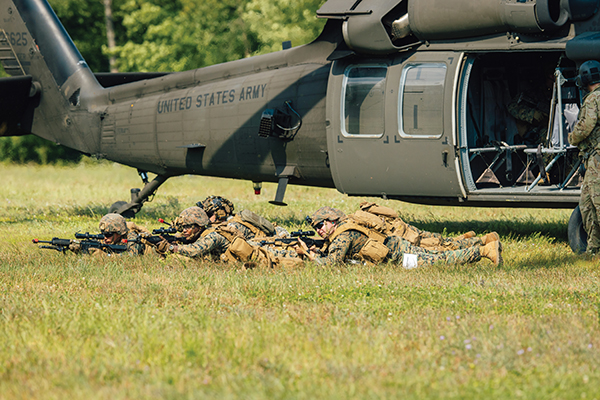
Michigan’s defense assets span every region of the state and continue to grow stronger. The Michigan National Guard’s National All-Domain Warfighting Center (NADWC) stretches across northern Michigan, incorporating the Alpena Combat Readiness Training Center, the largest military airspace east of the Mississippi River with 17,000 square miles of special-use military airspace, and Camp Grayling, the nation’s largest National Guard training installation. It provides training for the DOD and other government agencies across land, air, maritime, cyber and space domains.
Just north of Detroit, Macomb County is the site of the Michigan Defense Corridor, a concentration of defense companies and military facilities including BAE Systems, General Dynamics Land Systems, Oshkosh Defense, GM Defense and Raytheon Technologies. In 2024, Macomb County companies were awarded more than 4,800 defense contracts worth $3.2 billion.
The U.S. Army Detroit Arsenal, also located in the Corridor, is home to two Army Commands and several related organizations. One is the Army Contracting Command-Detroit Arsenal, which handles contracting for 70 percent of everything the Army buys. Another is the Ground Vehicle Systems Center, the nation’s laboratory for advanced military automotive technology, where more than 1,000 researchers and engineers develop and maintain vehicles for all U.S. Army Forces, many federal agencies and more than 60 foreign countries.
On the Front Lines of Michigan’s Defense and Aerospace Industry
In April 2025, Michigan secured a game-changing new mission of F-15EX fighters at Selfridge Air National Guard Base in Harrison Township. The announcement cemented years of bipartisan advocacy by state officials, the congressional delegation and local partners to protect Selfridge’s $850 million annual economic impact.
The F-15EX, a Boeing aircraft which entered service in July 2024, is expected to replace the remaining F-15C/D fighters in the U.S. Air Force and Air National Guard. With its legacy of serving F-16s and A-10s, Selfridge is well equipped to support a fighter mission, which includes not just aircraft but also auxiliary and support staff and materials. The base will also host a new KC-46A tanker mission, announced in January 2024.
AM General LLC, which produces specialized vehicles for military and other customers, sited its Technology & Engineering Center in Auburn Hills. ND Defense, maker of the ATLAS family of all-terrain vehicles with military-grade engineering, among other vehicles and battlefield systems, is headquartered in Madison Heights.
In 2023, the U.S. Army announced that two Michigan companies, General Dynamics Land Systems and American Rheinmetall Vehicles, had been chosen as finalists in the XM30 Combat Vehicle program to replace the 1980s-era Bradley Infantry Fighting Vehicle. Both were contracted by the army to provide prototype vehicles for test and evaluation, with plans to select one of the vehicles for production in late Fiscal Year 2027.
Michigan’s Defense Innovation Ecosystem

In 2024, Michigan officially launched its first “Infrastructure for Innovation” agreement between the Michigan Economic Development Corporation (MEDC), which houses ODAI, and the Michigan National Guard (MING) to engage Michigan’s defense-focused innovation resources and make relevant critical infrastructure available to entrepreneurs so they can advance and test their ideas. The Infrastructure for Innovation initiative was created by an Executive Directive instructing state agencies to catalogue technology, equipment and facilities across the state and work with the owners to make it available to innovators who need it.
The impact of this strategy was on display in February 2025, when a Michigan delegation attended the International Defence Exhibition and Conference (IDEX) in Abu Dhabi, one of the world’s premier defense and security trade shows. Michigan companies that exhibited at IDEX collectively achieved $3.5 million in expected sales in the next three months, for a significant return on investment.
Michigan’s manufacturing prowess also benefits naval applications, and in July 2024, Governor Whitmer announced a $50-plus million partnership with the DOD and U.S. Department of Labor called the Michigan Maritime Manufacturing (M3) Initiative, oriented toward education and supplier development.
The M3 Initiative teaches critical skills for maritime construction, particularly in maritime welding and machining, through local community colleges and connects K-12 students with hands-on career and technical education. ODAI also reaches M3 suppliers through a monthly webinar series and an invitation-only supplier conference focused on specific commodities related to submarine and shipbuilding opportunities.
In Houghton County in Michigan’s Upper Peninsula, one of those suppliers has a growing national and international presence. Great Lakes Sound & Vibration was selected in 2022 to supply exhaust mufflers for the U.S. Marine Corps Assault Amphibious Vehicle (AAV). The AAV is a fully tracked amphibious landing vehicle and is the current amphibious troop transport vehicle of the U.S. Marine Corps.
Beyond land and water, Michigan’s strategic approach to advanced air mobility (AAM) includes development of an integrated manufacturing and innovation ecosystem through the AAM Activation Fund, which supported four major projects in 2024, and through its Michigan AAM Initiative, established through an executive directive in July 2025.
AAM also played a major role in the first-ever Uncrewed Triple Challenge (UTC) held in May 2025, a groundbreaking, state-sponsored competition of autonomous drones across multiple domains, including water, air and land. The UTC challenged nine teams to autonomously transport a package across water, air and land with no human intervention through a rigorous course: 10 miles on the water from the Alpena harbor into Thunder Bay and back, 58.5 miles through the skies to Camp Grayling and 23.5 miles across rugged terrain to the finish line.
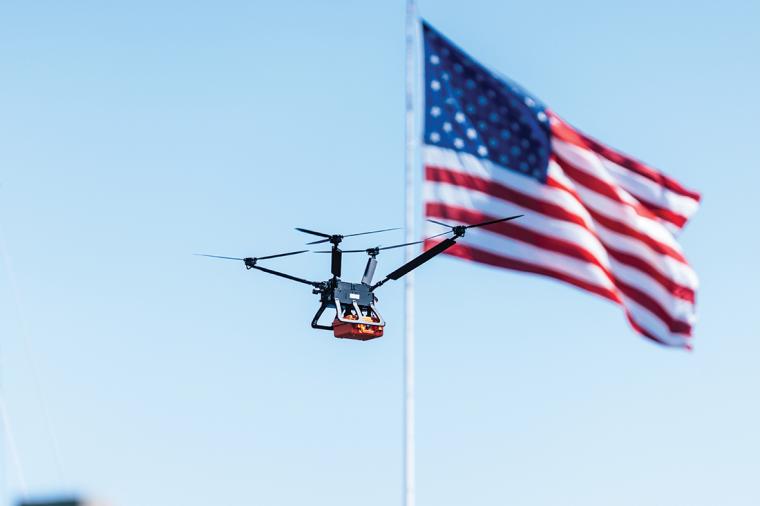
Drone manufacturer SiFly came into its own as a world record holder, when its Q12 became the longest-flying delivery quadcopter in the world. It carried a 10.6-pound payload as it completed a 63-mile autonomous mission, with two 26-mile legs per battery – more than double the previous 11-mile record – while battling sustained 15 mph winds with gusts up to 32 mph.
From its manufacturing facilities and flight decks to the waters that shape the state, Michigan remains the nation’s proving ground for the next era of defense and aerospace leadership.
To learn more about why companies are choosing to Make It in Michigan, visit michiganbusiness.org/pure-opportunity. T&iD
Related Agencies
About the Author