
North Carolina is in an unprecedented period of reinvestment for its biomanufacturing workforce training. Community colleges across the state have been making investments exceeding $230 million over the past few years. This commitment to new and expanded life sciences training programs and facilities builds on the state's history and strength in workforce development.
This scale of training investment is in response to a significant period of pharmaceutical industry expansion across North Carolina. Since 2021, life sciences companies have announced plans to invest $24.5 billion in new or expanded facilities, mostly manufacturing sites. These announcements have the potential to create over 15,000 new jobs.
Just last week, AbbVie announced a $1.4 billion investment to build a new drug production facility on a 185-acre campus in Durham County, where the company expects to employ 734 people.
Global Location Strategies recognized the Research Triangle area as the top U.S. location for biomanufacturing in its 2026 Pharmaceutical Manufacturing Insight Report. Leading companies with construction underway for major production facilities include Amgen, Biogen, Genentech, Eli Lilly, FUJIFILM Biotechnologies, Johnson & Johnson, Novo Nordisk, and Novartis. These expanded sites will join the state’s existing 170 life sciences production sites that currently employ nearly 36,000 North Carolinians in specialized jobs.
A foundation of collaborative investment
While the current $230 million investment in training infrastructure is substantial, it is part of a decades-long economic strategy. In the 1950s, the state was heavily dependent on agriculture and textiles. Today, it is recognized as a leading life sciences hub with global impacts.
This economic shift was supported by early, targeted collaboration. In the late 1990s, a partnership between the North Carolina Biotechnology Center and the North Carolina Community Colleges System led to the creation of BioWork, a certificate program that has been the bedrock of N.C.’s biomanufacturing workforce strategy for the last 25 years. This foundational program set the stage for a broader wave of workforce development investments in the early 2000s.
State leaders, spanning NCBiotech, NCBIO (now known as NCLifeSci), both the UNC and NC Community Colleges systems, the Golden LEAF Foundation, and employers, anticipated a need for biomanufacturing capacity as the industry matured and funded new training initiatives under the banner of NCBioImpact, which was advanced significantly by the Golden LEAF Foundation’s $67 million investment in infrastructure, including:
BioNetwork: An initiative linking facilities, courses, certificates, workshops, and company-specific skill development in biomanufacturing and pharmaceuticals across the NC Community Colleges System’s 58 colleges.
The Golden LEAF Biomanufacturing Training and Education Center (BTEC): A simulated biomanufacturing facility at North Carolina State University spanning 77,700 square feet with pilot-scale bioprocessing equipment. The facility provides hands-on training in current Good Manufacturing Practices for undergraduates, graduate students, and working professionals.
The Biomanufacturing Research Institute and Technology Enterprise (BRITE): A state-of-the-art research and education center at North Carolina Central University that supports biomanufacturing training by providing students with hands-on experience in professional-grade laboratories and curricula developed in partnership with leading biotech companies.
These programs prepared the initial workforce talent that helped anchor North Carolina as a leading location for biomanufacturing, facilitating the attraction of billions of dollars in new production facilities over the last two decades.
The first inflection point was the Golden LEAF Foundation investment. The next major milestone came in 2022 when a statewide coalition of public and private organizations led by NCBiotech was awarded a $25 million federal Build Back Better Regional Challenge grant. We called it Accelerate NC, and the coalition invested in developing sustainable workforce development initiatives that continue today.
While North Carolina’s success is deeply rooted in a legacy of global leadership in biomanufacturing workforce development, the state is leading the way once again through a period of unprecedented investment across our Community College System. This expansion ensures we have the capacity to not only support current company manufacturing expansions, but we are doubling down again on workforce training to accommodate future growth of the industry. As in the past, North Carolina’s focus remains on providing top talent that supports the industry's ability to safely and efficiently translate and scale innovations to improve patient outcomes.
Training the workforce of tomorrow
The current wave of community college investment arrives as the biomanufacturing sector undergoes a rapid transformation driven by advancing technologies, including AI, automation, robotics, and augmented reality. Furthermore, companies face increasing demands for efficiency and speed-to-market to deliver therapies to patients. Regions that can provide adaptable workforce development programs attuned to the industry's changing technological needs hold a distinct advantage in life sciences manufacturing recruitment and expansion. North Carolina is building upon its industry-led approach to training by expanding the scope and scale of its community college infrastructure.
Select community college infrastructure projects include:
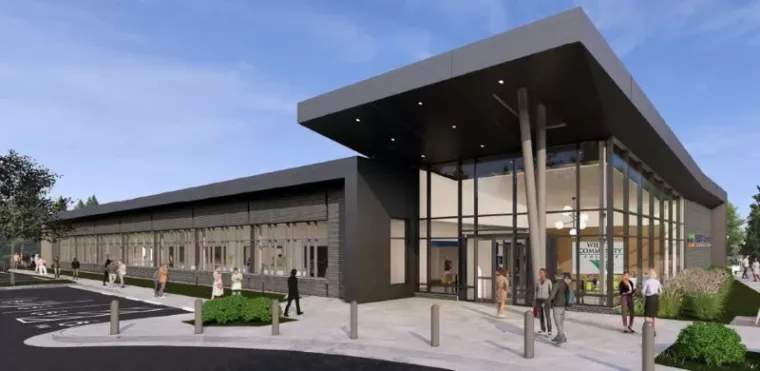
BEST Center of Eastern North Carolina: Wilson Technical Community College has begun construction on the nearly 30,000-square-foot Biomanufacturing Education and Skills Training (BEST) Center of Eastern North Carolina. Scheduled to open in 2027, the BEST Center will leverage industrial equipment and real-world learning experiences to prepare students for careers in biologic drug substance and drug product manufacturing. The BEST Center, to be operated by Wilson Community College, plans to train up to 500 people a year for jobs at life sciences companies in the region. The North Carolina General Assembly committed $30 million for the BEST Center plus $10 million for operating costs, and the Golden LEAF Foundation provided $13 million in funding.
WCC Best Center
A rendering of WCC's Best Center.
Central Carolina Community College: The college is advancing a major renovation of the E. Eugene Moore Manufacturing and Biotech Solutions Center with over $35 million invested to date. This investment will include the construction of a dedicated 10,000-square-foot biotechnology facility. This new space is designed to simulate modern industrial environments—featuring cleanrooms, fermentation labs, and fill/finish areas—to directly support the growing life sciences companies in the region.
Durham Technical Community College: The college, in partnership with Novo Nordisk, recently broke ground on the 35,000-square-foot Novo Nordisk Life Sciences Center, designed to prepare students for careers in biotechnology. Once complete in 2026, the training center will house on-site training for biotechnology career transition programs to upskill and reskill existing employees. Durham County committed over $35 million for the project, and Novo Nordisk granted $6 million. Biogen also pledged $250,000 to strengthen the BioWork program at the new center.
Durham Tech breaks ground
Durham Tech, Novo Nordisk and local government officials broke ground at the soon-to-be-built life sciences center.
Pitt Community College: The Pharmaceutical Services Network (PSN) at Pitt Community College recently completed a major upgrade of its aseptic training facility, incorporating isolator environment technology that reflects current industry trends. The facility also features three virtual reality (VR) training platforms using Meta Quest headsets to introduce high school students to pharmaceutical manufacturing careers. The PSN launched in 2018.
South Piedmont Community College: The college is building a new 21,000-square-foot Aseptic Training Facility in Monroe that will provide hands-on training in sterile processes for students entering the pharmaceutical and biotechnology industries. Scheduled to open in 2026, the facility is southeast of Charlotte and will feature classrooms, labs, and simulated manufacturing operations, including an Aseptic Training Facility. The project received $8.4 million in state funds, $480,000 from Golden LEAF, and a donation of over $1 million in equipment from Glenmark Pharmaceuticals.
Wake Technical Community College: The college opened a new Eastern Wake campus in 2024 and began building a $60 million Advanced Technology Center that will house its Biopharmaceutical Technology degree program. The facility will offer a simulated biopharmaceutical work environment focusing on upstream fermentation and downstream purification processes. Wake Tech is also building a new $115 million Conlon Western Wake Campus in Apex, south of Research Triangle Park. When it opens in 2029, the campus will offer programs in biotechnology, health sciences, and advanced manufacturing. In partnership with NC Life Sciences Apprenticeship Consortium companies, including Amgen, Eli Lilly, FUJIFILM Biotechnologies and CSL Seqirus, the college has also established “learn and earn” apprenticeship programs.
In addition to these projects, several other community colleges across North Carolina are making investments in support of biotechnology and biomanufacturing training.
North Carolina’s milestone of exceeding $230 million in biomanufacturing workforce training investments marks an unprecedented period of growth. This unrivaled commitment to expanding life sciences training builds directly on a legacy of global leadership in talent development established over the past two decades.
As the sector undergoes a rapid transformation, these community college projects build upon the state’s strong foundation to provide the adaptable programs needed to meet industry's evolving technology. By doubling down on its workforce training capacity, North Carolina builds upon its reputation as a trusted partner to the global pharmaceutical industry.
Ultimately, these investments ensure the state will remain equipped to translate and scale the next wave of life sciences innovations, delivering critical therapies to patients and continuing to drive economic benefit for North Carolinians well into the future.
By Bill Bullock, senior vice president for economic and statewide development for NCBiotech.
There are no comments
Please login to post comments