
From its access to critical international distribution points to its subtropical climate, South Carolina is exceptionally positioned to launch and sustain legacy businesses. Its commitment to business recruitment and retention has resulted in a diversified economy built to innovate.
In 2025 alone, South Carolina announced $9.12 billion in capital investment — marking the highest percentage of rural jobs and investment since 2010. The Palmetto State also reached $38.5 billion in export sales last year, and with its $300 billion manufacturing footprint, the state continues to demonstrate that success is found in South Carolina.
A Driving Economic Force
Heralding its eleventh consecutive year as the United States’ largest exporter of tires, South Carolina maintained its status as a leader in automotive manufacturing and distribution in 2025. In fact, the state’s $2 billion in tire export sales accounted for 43 percent of the U.S. market share, and motor vehicles and parts were the state’s top exported commodities. Completed passenger vehicles held 18 percent of the American market share — the highest in the U.S., earning $9.8 billion in sales.
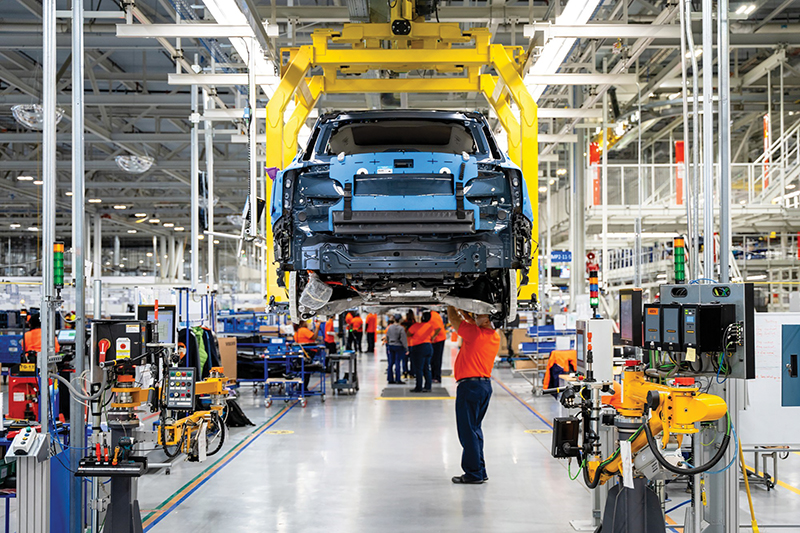
South Carolina is home to several trusted automotive companies including BMW, Mercedes-Benz Vans, Michelin, Bridgestone and Volvo, which recently celebrated 10 years of operations in the Palmetto State. Volvo is also expanding its production capacity in South Carolina; the company announced it was not only adding its bestselling XC60 to its Dorchester County lineup, but it is also consolidating all Polestar 3 manufacturing to its Lowcountry facility, reaffirming the state’s global influence.
Alongside Volvo’s expansion, South Carolina recently welcomed several automotive-related companies to its landscape. In December 2025, SODECIA AAPICO Joint Venture announced that it was selecting Orangeburg County for its first operation in South Carolina. The two international manufacturers formed a joint venture to produce advanced ladder frames for Scout Motors, an all-electric automotive manufacturer establishing its first production facility in Richland County. Scout’s announced $2 billion in investment in its South Carolina plant, which is expected to begin operations this year, further demonstrates South Carolina’s capacity to support businesses through all stages of growth.
In South Carolina’s Upstate region, ZF Chassis Systems Duncan announced in September 2025 that it is expanding its capabilities as a leading supplier of chassis systems, modules and assemblies. Automotive supplier ElringKlinger also announced a nearly $70 million investment in its Pickens County production facility in October 2025, demonstrating the continued opportunities available within South Carolina’s automotive industry.
Soaring for Success
South Carolina also maintains a thriving aerospace industry. In 2025, aircraft and parts were South Carolina’s second-most exported commodities, with aircraft
exports to Taiwan and Qatar significantly increasing compared to 2024.
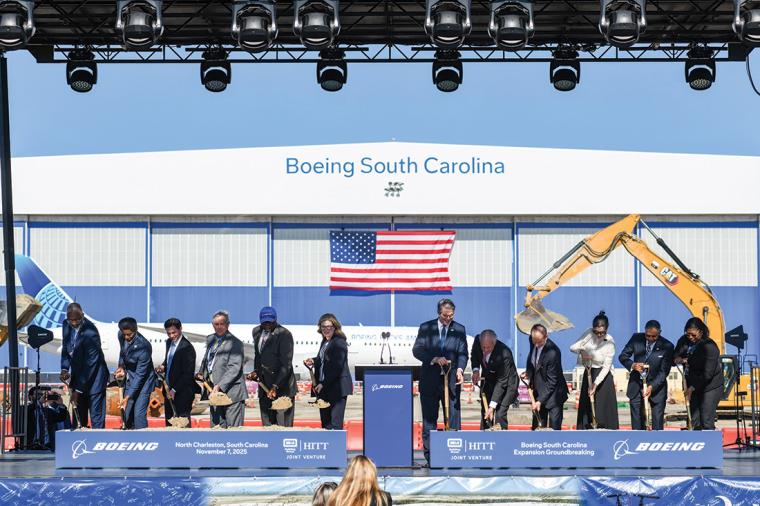
Boeing, one of the world’s largest aerospace companies and defense manufacturers, operates two campuses in South Carolina, employing more than 8,000 workers and partnering with nearly 200 regional suppliers. Since 2012, Boeing has fabricated, assembled and delivered its innovative 787 Dreamliners in South Carolina. In November 2025, the company broke ground on the $1 billion expansion of its 787 Dreamliner production facilities, which is expected to increase its production capacity to at least 10 aircraft per month.
Eaton, a power management technologies provider, is also expanding its aerospace capabilities at its Charleston County plant. The company’s new development in the Lowcountry will increase its additive manufacturing, machining, assembly and testing capabilities, reinforcing South Carolina’s position as a leader in technological innovation.
Additionally, in September 2025, Woodward, a global leader of energy conversion and control solutions, announced it is establishing operations in Spartanburg County. Reflecting an investment of nearly $200 million in the Upstate, operations at Woodward’s new precision manufacturing facility are expected to be online in 2027 and will supply Airbus with spoiler actuation systems.
ATI Inc. also announced the expansion of its South Carolina manufacturing capabilities last August. The international aerospace and defense company’s Chesterfield County manufacturing facility produces titanium alloy sheet, a critical component in aircraft manufacturing. ATI is a partner of Airbus and Boeing, demonstrating the state’s interconnected business network.

Carolina Grown
As one of the state’s oldest and fastest-growing industries, agribusiness has an annual impact of more than $50 billion. The state’s warm, Southern weather provides optimal conditions for agribusiness production, supply and distribution. In the last year, South Carolina has bolstered its forestry and wood products sector with the addition of several significant investors like Eastover Chips, a subsidiary of The Price Companies, which announced plans for a new wood chipping facility in Richland County.
Many agribusiness enterprises have been capitalizing on one of South Carolina’s most strategic advantages: its rural counties. Rural areas of South Carolina offer a competitive workforce pool, expansive site opportunities and more significant development incentives. In fact, of the $9.12 billion capital investment and more than 8,100 new jobs announced in South Carolina in 2025, more than 40 percent went to rural areas, representing the highest percentages in more than a decade.
In April 2026, Ferrara Candy Company (Ferrara) announced its first South Carolina facility in rural Orangeburg County. Ferrara, which makes household-name products like NERDS, SweeTARTS, Laffy Taffy and Brach’s, is investing $675 million in South Carolina and creating 1,000 new jobs, reflecting a strong confidence in South Carolina’s economic climate. Carolina Renewable Products, a clean energy company that converts wood biomass into renewable energy sources, is also establishing its headquarters in Orangeburg County.
Wood materials manufacturer Homanit is taking advantage of rural South Carolina’s resources by establishing its U.S. manufacturing presence in Clarendon County. With an investment of $250 million, the German company’s new facility will produce fiberboards for its American customers. In Allendale County, Hampton Lumber, an Oregon-based producer of sustainable building materials, announced that it would be constructing its first sawmill on the East Coast, demonstrating the strength of South Carolina’s rural workforce.
ceremony for its recent expansion on Nov. 7, 2025. Photo provided by Boeing.
Powering the Future
Alongside its aerospace, agribusiness and automotive industries, South Carolina has also been leading the way in energy innovation thanks to the SC Nexus for Advanced Resilient Energy (SC NEXUS). Earlier this year, the U.S. Department of Commerce approved SC NEXUS’ request to expand its geographic footprint from the Midlands, Upstate and Augusta, Georgia regions to the entire state of South Carolina, making the organization the first U.S. Tech Hub to garner a statewide designation.
Additionally, SC NEXUS recently launched an innovative partnership with the South Carolina Research Authority (SCRA). The two organizations created the Entrepreneurship and Innovation Exchange (eiX) program, which aligns energy-related startups with state resources and funding to bolster South Carolina’s position as a leader in the energy sector.
Why SC
South Carolina isn’t just a home for businesses — it’s a haven for its residents thanks to its ecological diversity, relaxed pace of life and welcoming Southern charm. Between July 2024 and 2025, South Carolina saw the highest population growth of any state in the U.S., demonstrating the state’s livability and opportunity.
As a leading international recruiter, the South Carolina Department of Commerce (S.C. Commerce) has offices in Germany, Japan, Korea, Taiwan and the United Kingdom. In 2025, the European office celebrated its 50th anniversary, demonstrating South Carolina’s commitment to industry recruitment and economic development.
By extension, the state provides ample resources for businesses looking for new opportunities in South Carolina. S.C. Commerce offers a comprehensive Landing Pad program which assists international and national businesses with navigating the Palmetto State’s economic development resources. Another beneficial tool for businesses looking to scale in South Carolina is LocateSC, a unique online site selection catalogue. In addition, thanks to readySC, South Carolina offers opportunities for access to a strong workforce pipeline for skilled workers. Overall, South Carolina’s comprehensive advantages and assets create an ideal environment for businesses to launch and grow while leaving a lasting legacy.
RESOURCES
SC NEXUS (www.sccommerce.com/scnexus) is South Carolina’s federally designated tech hub aimed at strengthening domestic manufacturing and national energy security. SC NEXUS offers companies and entrepreneurs the perfect environment to develop, test and deploy exportable electricity technologies.
Landing Pad (landingpad@sccommerce.com) is a program that connects growth-phase companies with experienced industry professionals. This S.C. Commerce initiative provides support for international and domestic businesses looking to scale in South Carolina with a point of contact.
LocateSC (www.locatesc.sccommerce.com) is an online site selection tool used to promote business relocation and expansion. This user-friendly platform includes property listings and workforce data for businesses, site selectors, realtors and other economic development stakeholders.
readySC (www.readysc.org) is a valuable tool used to promote economic development and provide companies customized recruiting and training solutions. As an integral part of the South Carolina Technical College System, readySC works with 16 technical colleges to prepare the state’s workforce to meet any company’s needs. T&ID
Related Agencies
About the Author